
When you think about the paleo diet breakfast you need to think a little like a caveman. I know that sounds really strange but the foods that cavemen ate were what humans were basically meant to eat. Meat, fish, fowl, eggs, berries, root vegetables and some kinds of nuts are the basics for a healthy paleo diet.
Most of us eat a whole array of starchy, sweet, salty, processed foods that were never meant to be a part of the human diet. I could go into a lengthy explanation about how our diet evolved to include these foods but that’s not what this article is about. This article is about what you CAN EAT for a paleo diet breakfast!
Now the purpose of breakfast is to “break” the “fast” that your body has been in since last eating the evening before. This is the best time to boost your energy with protein and healthy nutrients. Most people enjoy a full breakfast but some prefer to skip this meal and wait a few hours to have that first meal.
This is okay as long as you are listening to the signs your body is giving you. If you truly don’t feel hungry that’s fine, but don’t skip breakfast just because you are rushing. It will catch up with you later in the day by giving you headaches and stomach pains, brain fog and irritability.
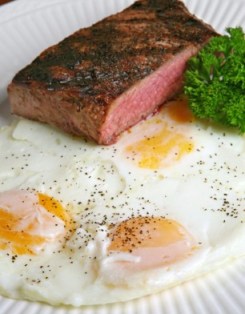
For a healthy paleo diet breakfast, skip the coffee with sugar, the whole grain toast, cereal, bagel or muffin. Start with a cup of tea (no sweetener) or coconut milk. Then bust out the bacon and eggs! That’s what I love about this diet; I can have my hearty ham or steak and some pastured scrambled eggs and not feel guilty. Avoid the potatoes, grits, oats, toast, bagels or English muffin, they just turn to sucrose in your body and get stored as fat.
Feel free to substitute chicken or fish as your protein because you can eat these anytime on a paleo diet, even for breakfast. Once you get used to eating a piece of salmon or other fish with your veggies or fruit for breakfast you will realize what you’ve been missing. Grab whatever leftovers are in the fridge and make breakfast out of it.
If you don’t enjoy the old fashioned country breakfast every day, then make a quick
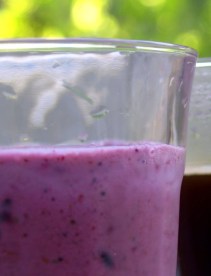
smoothie in the blender with coconut milk, some fresh strawberries, blueberries, and banana with a little ice. If you have a good source for pastured eggs you can one or two of those. It is lighter and gives your body some energy without spiking your blood sugar.
Another great paleo diet breakfast is a fresh green salad. In some Mediterranean countries a traditional breakfast includes eggs and fresh greens with zucchini, tomatoes, cucumbers and carrots. Again, don’t grab for the pita or the couscous which both are made with processed flour, a big no-no. Add a few crumbled or chopped almonds or walnuts instead.
I hope I’ve given you some helpful ideas on what to cook up for breakfast on a paleo diet. Just remember to be creative with these healthy ingredients and think outside the box. I know you can do this, and I know you’re going to love it!













1 comment
"nutrition nut"
February 12, 2012 at 1:47 am (UTC -5) Link to this comment
re: “Avoid the potatoes, grits, oats, toast, bagels or English muffin, they just turn to sucrose in your body and get stored as fat.”
Starches from natural foodstuffs without added sweeteners, do not turn into sucrose. Sucrose is a disaccharide. When broken down by human digestion it becomes 50% each glucose and fructose. It comes mainly from cane and beet sugar and also present in fruit and vegetables but NOT from starch food sources. Starches from grains break down to maltose and then to glucose. These sugars are monitored in the body and have not been shown to cause obesity or other disorders by themselves. Rather misinformation and incorrect deductions are wrongly responsible for such associations.
It is ridiculous to infer that your body does not store fat (triglycerides) if you don’t eat starches! This is the natural process of eating ANY glucose reducible foods (unless you wish to constantly snack – but then sooner or later you will do so in excess ) . The body will store that energy, first as glycogen, if liver and muscle stores are low and then as triglycerides, to be deposited as body fat. It does not matter what you eat, if you eat in excess of your energy needs the excess is always stored as fat. Excess fat is also stored unless a medical condition is present.
Except if insulin resistance is present the same fat stores are then reconverted back to energy to be used by the cells (mostly brain cells). Fat stores are THE way of keeping the body and brain running smoothly and cleanly. The alternative is to constantly snack to keep blood sugars constant – this may be ok for cattle in a paddock but humans have historically adapted to eat far less often over the day. It is even built into our many cultures still.
The thing is when we are healthy, the body is able to regulate itself. It has hormone messengers that detect when levels are exceeded and sets to re-balance itself so that the eating urge subsides. Both fats and glucose are regulated in this way. And so long as all the energy in foods consumed can break down into these components all is well. Anything outside this is dealt with by the liver and eliminatory systems which play a detoxifying role.
The problem has been the increasing use of unnatural and toxic food-stuffs such as highly damaged fats (processed oils, margarines,) and excessive fructose found in all processed foods containing sugar or HFCS.
Until insulin resistance is corrected by avoiding damaged fats and reducing fructose to minimal amounts, no amount of starch reduction on its own will statistically correct the problem. This is because a great deal of will power (the overriding of natural body urges and functions) has to be maintained, yet the cause is not being addressed. Statistically most fail on will-power for weight control: it is unnatural not to react to natural hunger signals!
The breakfasts recommended above ‘work’ because of the high level of fats that set off satiety hormones. Nothing wrong with that unless they are heat damaged, or a deficiency of the essential fats exists. As with excess sugar that crowds out the fresh foods containing vitamins and minerals, consideration must be given to include the fats that are anti-inflammatory instead of those that double dip into your health credits by filling you up but cause damage as they do!
Re Blood sugar “spike”. This is not a medical condition! It simply refers to the high end of the glucose reading in a given period. It is misleading to infer that one can avoid a spike anymore than on can avoid feeling the ‘spike’ of feeling full. The only way to avoid a spike is to remain hungry! Insulin must be triggered after every instance of eating otherwise we would continue to eat. ‘Spikes’ in blood sugar are controlled naturally by the body’s hormone signals unless medical conditions have already occurred to interfere, such as with IR.
Everyone should avoid excess (especially processed) hi-fructose foods and damaged fats, and choose a food intake of fresh ingredients, and starchy staples as these have historically sustained humans in famine conditions and the body is attuned to know when enough is enough of them.